
 Posted by
 Sudoku with a Secret! What fun! (available on Amazon)
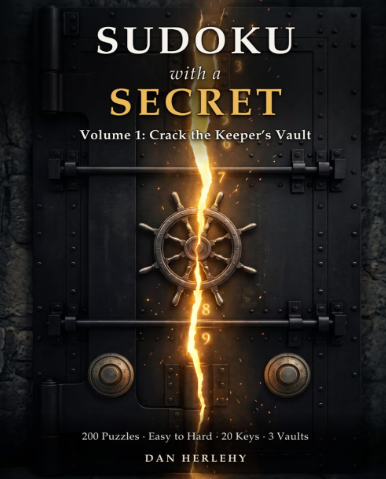
What happens when a lifelong love of puzzles meets the creativity of an escape room? Dan Herlehy, an industrial engineer by training and longtime puzzle and mystery enthusiast, has turned that idea into Sudoku with a Secret. His first volume combines 200 original Sudoku puzzles with a hidden, multi-stage adventure that takes solvers from the printed page to an online vault. EXCITING!
In this Six Questions, Dan takes us behind the scenes of creating the book – from designing the hidden puzzle layer and testing every step for fairness to building an experience where solvers can choose how deeply they want to explore. And with four more volumes planned, the adventure is just beginning!
Six Questions with Dan:
- 1Q) I love Sudoku – and your book! Congrats on its publishing! Please share more about Sudoku with a Secret! What can puzzlers expect – and where can they get it?
Thank you! It’s 200 Sudoku puzzles, and there’s an escape room hidden inside them.
Some of the puzzles have one shaded square sitting in them. Solve the puzzle and that square hands you a digit. Collect enough of them, and a table in the back of the book turns them into a word, and that word opens a sealed vault on the website. You don’t have to finish all 200 to get to the first one either — you can be standing at that first door before you’re a third of the way through the book.
And there’s one more word in there that’s never been announced anywhere. It’s findable from the book alone, and one person has already solved it. I was a little nervous I made it too hard.
If you never want any of the secret, it’s just a Sudoku book, and I took that part seriously. One 9×9 grid to a full 8.5×11 page, easy up front and hard in the back. The page size was on purpose. One grid to a full page means big squares with real room to pencil in candidates, which is a lot easier on older eyes than the little ones you get four to a page. The story pages and the answer keys are ordinary print, so it isn’t a large-print edition — but the Sudoku itself is large print, and the solving is comfortable, and that was important to me.
The other thing I didn’t want was a book that’s just grids on paper. Every puzzle sits inside a border, and the border is a vault door, and the door takes a beating as you go. There are three of them actually, one for each act, and each one starts off clean and gets steadily wrecked — cracks spreading out from the welds, a hinge torn loose, a dial knocked off its face, rivets popped. By the last page the big handwheel has been torn clean off its mount and it’s lying on the floor. It’s a progress bar you can see. So even if you never go near the secret, I wanted to give a Sudoku player something more than just a bunch of grids on a piece of paper.
The book can be purchased on amazon: https://amzn.to/
- 2Q) Have you always loved puzzles? What sparked the idea for Sudoku with a Secret? What made you want to take the familiar puzzle and turn it into something with a hidden mystery and an additional layer to discover?
Always. My dad handed me one of those tangled metal puzzles when I was a kid, the kind where the two pieces stuck together and you’re sure somebody is playing a joke on you, and that was pretty much it for me. After that it was a new puzzle every birthday and every holiday, and they kept getting harder — ciphers, puzzle books, escape rooms later on. Even those books where you got to the bottom of a page and picked what happened next and it sent you off somewhere else. I never grew out of any of it.
So there’s plenty out there that does this kind of thing, and your readers know it better than I do — people have been pulling letters out of grids for as long as there have been hunts. What I could never find was a Sudoku book on a shelf that did it front to back, as one quest. The closest thing I ever found was The Sudoku Code from back in 2006, and that’s long out of print and does something pretty different. And the thing that always kind of bugged me about puzzle books is that you finish the last page and that’s it, it’s over, nothing really happens. So I ultimately just built the one I wanted.
- 3Q) The Sudoku Puzzles contain something more. Without giving away the secrets, what can you tell us about how you designed that hidden layer? How early did you know exactly how the pieces would come together? Please share more about your process on creating the puzzle – through writing and testing to then leading puzzlers to a satisfying solution.
The secret came first, in the sense that I knew the words and the three acts and how each one would get harder before I had built a single grid. Then the grids had to be made to carry it, and that’s a constraint an ordinary Sudoku book never has to deal with — every key digit has to land in a square that the solve actually reaches, blank on the puzzle page and right in the solution.
The writing came out of that too. There’s a Keeper in the book and he writes you three letters, one before each act. Those letters have two jobs at once: they read like somebody actually sat down and wrote them to you, and they carry the thing you need. That was the hardest writing I did, because a letter that’s only a puzzle in disguise reads like a form, and a letter that’s only a letter is no use to you.
There’s a line in the front that gives you the shape without spoiling anything: Act I is easy, Act II is medium, and Act III will take patience. The first one is just a straight lookup, anybody can do it. The second one changes the rules on you, and the third one changes them again. The Keeper does warn you both times, he’s not a cheat about it — but the true letters are printed nowhere in the book, so every last one of them you work out by hand. That’s the part I’m probably proudest of.
What I cared about most was that the secret be fair. Get one shaded square wrong and the word comes out wrong and the door doesn’t open, and you’d be left not knowing whose mistake it was. That was the thing I really couldn’t live with. So every grid was checked to have exactly one solution, and then the whole book was checked again, end to end, many times. And if you do get stuck there are nudges waiting for you, in the book and on the site, that’ll tell you which act to go back to.
- 4Q) The book eventually takes solvers beyond the pages and onto a companion website, where the discoveries continue. What did you want that transition from book to online adventure to feel like for the solver? What do you hope they experience when they finish the book and realize there was more there than they first saw?
I guess I wanted it to feel like you were actually opening something. Not just, here’s a link, go type this in.
The whole thing is pencil and paper right up until the end. No app, nothing to install, no account to make. You do all the work on paper, and then the first time you type your word in and the door actually swings open, that’s the moment I was building toward.
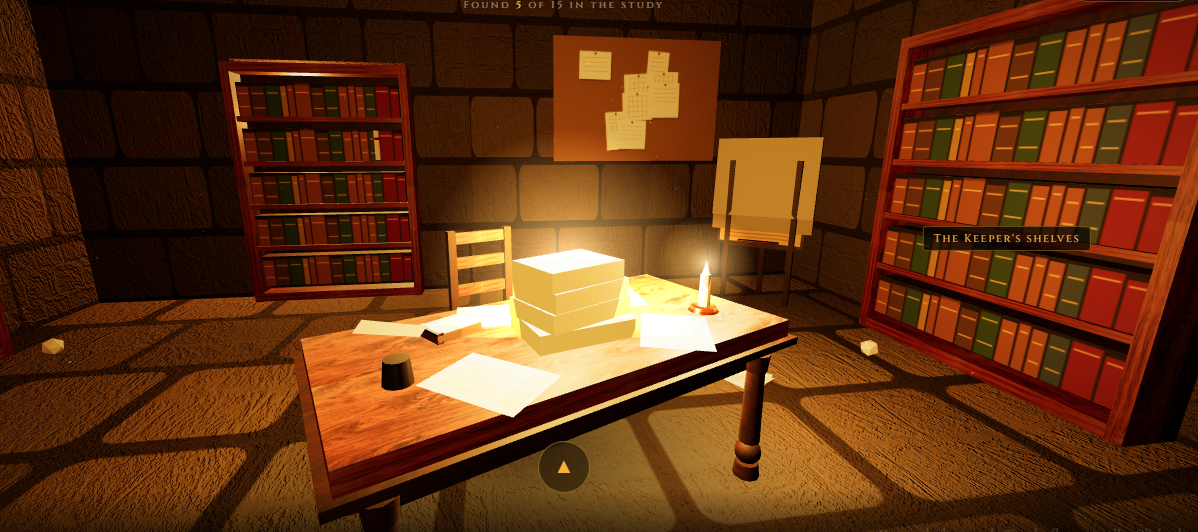
And what’s back there isn’t just a download. It’s a room, and you’re standing in it, on your phone or on a computer, and you can walk around and touch things and they answer you. There’s a way on from there to the next vault, and it’s hidden, but it’s findable and somebody has already been through it. I’d rather you had the moment of spotting it than have me point at it.
What I really hope for is the flip back. You get that first word, and then you go back through pages you already finished and the shaded squares you’d been ignoring for a hundred pages suddenly mean something. Same book you’ve been holding all week, you just didn’t know what half of it was for.
And then way down deep, well past the first room and further than most people are going to get, there’s a wall where you can carve your initials. Somebody actually got all the way down there and signed it for real!! I was a little worried it was too hard.
- 5Q) I love the idea that a person can simply sit down with a pencil and solve the Sudoku, while those who start noticing the hidden elements can go much deeper. Was creating different levels of discovery important to you?
That was really the one rule I set for myself right at the start, and then everything else kind of had to work around it. It has to work completely as an ordinary Sudoku book for somebody who never goes looking.
The shaded squares sit right there in plain sight and they don’t ask you for anything. If you just want a cup of coffee and a grid, nothing in the book nags at you or tells you you’re missing out. And if you look at one and think wait a minute, why is that square gray, there’s a whole second book underneath the first one.
Mostly I think it’s Sudoku players reading this, so I made the first vault or two easy on purpose. I’d like somebody who’s never been near an escape room to get curious enough to try one, and then find out they’re better at this than they expected. Maybe that opens a door onto other kinds of puzzles for them. And if it doesn’t, that’s perfectly fine too. That’s what the book is for in the first place.
- 6Q) You’ve called this the first volume, suggesting there is more to come. How much of the larger Sudoku with a Secret world is already mapped out? Can we expect the secrets, puzzles, or style of discovery to evolve in future volumes?
Five volumes planned, each with its own color and its own secret. Volume 2 is The Corsair’s Chart, then The Lost Love Letters, then The Silent Signal, then The Hollow Oak. Those aren’t placeholder names — each one has its cover and its theme, and each is built around its own kind of secret. Volume 2 is furthest along by a long way: its puzzles are already built, and already put through the same double-checking the first book got. What I won’t do is promise anybody a date.
I want the secret to keep getting harder and stranger. If you cracked Volume 1 you come into Volume 2 already knowing the rules can move on you, and then the fun is working out how they moved this time. The last thing I want is five books where you run the same lookup table five times.
The other thing I want to change is the storytelling. Volume 1 does some of that with the Keeper, but only some. I’d like the ones after it to carry a lot more story around the whole thing. The Keeper isn’t finished — there’s more of him to come.