
 Posted by
Alpha and Omega Treasure Hunt Overview:
- Released by Alpha and Omega (website)
- Clues within a graphic novel (available on Amazon)
- Fully Armchair
- Treasure valued at 5K+
A NEW full armchair treasure hunt, where every clue, even the final solution, can be discovered without ever leaving your home, has been released! These full armchair hunts are a great example of how treasure hunting isn’t just about exploring the outdoors, but it’s also about exploring history, ideas, exercising your mind, etc. – all from home.
Success doesn’t depend on hiking, GPS coordinates, or visiting landmarks. Instead, it’s about careful reading, recognizing patterns, connecting ideas, and solving the mystery hidden in the pages. They are a different kind of adventure.
Let’s learn more about the Alpha and Omega treasure hunt by its creator in the following Six Questions!
Six Questions with Alpha and Omega:
- 1Q) What inspiration led you to create this Easter Egg Challenge? Was there a specific idea or experience that sparked it? Have you worked (or currently working) on any treasure hunts?
The Easter Egg Challenge grew naturally out of the creation of Alpha and Omega: From Eternity Past to the Last Adam. The graphic novel took years of research, writing, and development, and along the way I found myself fascinated by the idea of layered storytelling. I wanted to create something that rewarded readers who paid close attention and were willing to dig deeper.
Rather than simply hide a few references throughout the book, I decided to build an actual challenge into the project. The result is a puzzle that exists alongside the story itself, encouraging readers to connect details, follow clues, and explore ideas that might otherwise be overlooked.
Part of the goal was to create a sense of adventure and discovery. Given the book’s focus on biblical history, ancient mysteries, and forgotten connections, I wanted the experience to feel less like completing a puzzle and more like following a trail of clues toward something hidden.
To the best of my knowledge, Easter Egg Challenges of this scale are extremely rare in graphic novels. In fact, I am not personally aware of another graphic novel that contains a built-in treasure hunt with a real-world prize attached to it.
- 2Q) What all will a searcher need to purchase (for the entire duration of the hunt) in order to solve the hunt and claim the prize? While research may be required, are all the clues needed to solve the hunt in its entirety fully contained within the comic book? Do they need the coins?
The challenge is entirely solvable with the purchase of a single copy of the graphic novel, which is now available on Amazon.
Although additional items related to the project are available for those who wish to explore further, no additional purchases are required to solve the challenge or claim the prize. Every additional clue that is not contained within the book is publicly accessible.
While the hunt is intended to evoke a sense of exploration and discovery, it is designed as a fully armchair treasure hunt and can be solved without traveling to any physical location.
- 3Q) The 500 year old coin sounds like an incredible treasure. Please share more information about this and the prize in general.
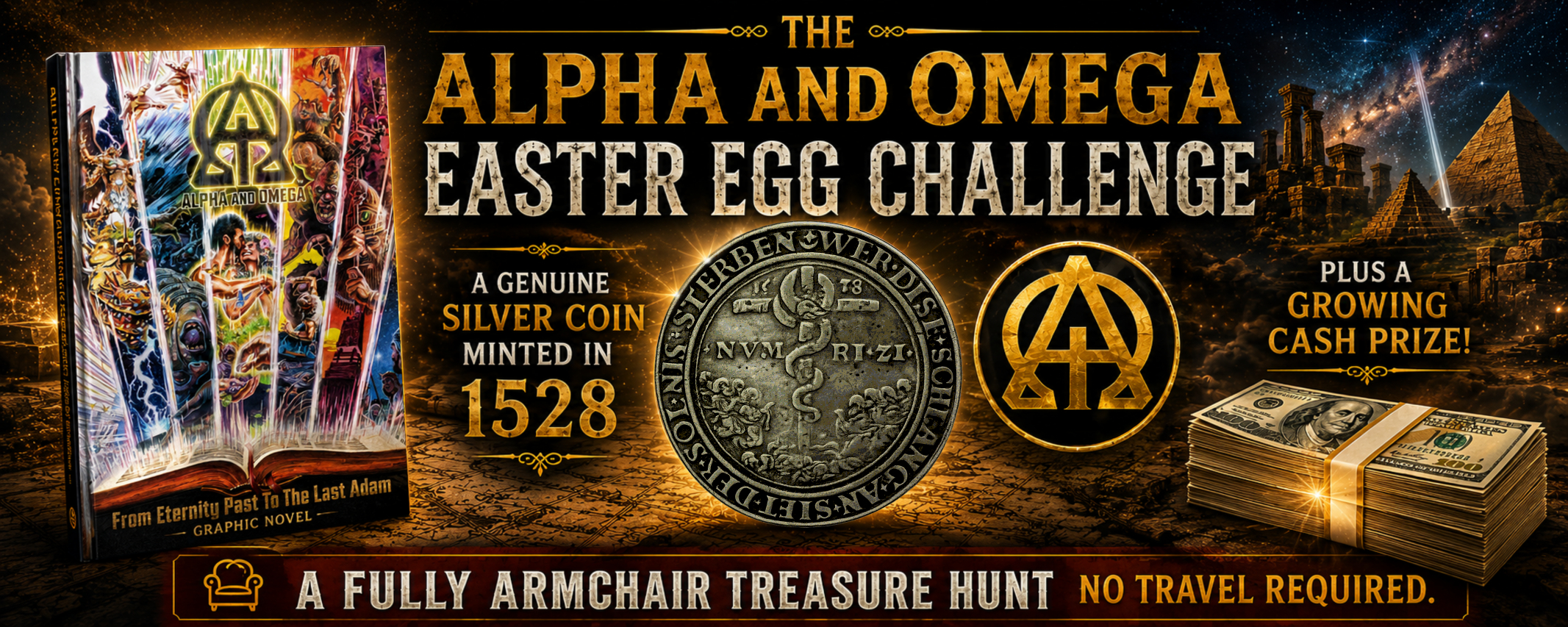
The grand prize consists of two parts: a genuine silver coin minted in 1528 and a growing cash prize.
The coin is nearly 500 years old and represents a fascinating piece of history from a period that helped shape the modern world. Similar examples have sold for thousands of dollars depending on rarity, condition, provenance, and market demand. Regardless of market value, the coin serves as a tangible connection to an era that few people ever have the opportunity to hold in their hands.
In addition to the historic coin, the winner will receive the Easter Egg Challenge cash prize. The cash prize is tied directly to the success of the Alpha and Omega project and is equal to 10% of total graphic novel sales. As additional copies are sold, the prize continues to grow. The current prize amount is always displayed on the Alpha and Omega website.
Combined, the prize package is currently valued in the thousands of dollars and continues to increase over time.
- 4Q) When you were building this challenge, did you start with the final solution and work backward, or did it evolve as you created it? Can you share a bit of your process?
The final solution came first.
I knew where I wanted participants to end up before I began designing individual clues. From there, I worked backward, building a chain of discoveries that would eventually lead searchers toward the answer.
One of the biggest challenges was balancing difficulty and fairness. I wanted the puzzle to be challenging enough to remain engaging, while still ensuring that every step could be logically deduced. Throughout the process, I repeatedly reviewed clues to remove unnecessary ambiguity and make sure the hunt remained both challenging and fair.
The goal was never to create an impossible puzzle. The goal was to create a rewarding one.
- 5Q) Who did you have in mind when creating this: Experienced hunters, newcomers, or a mix? Does the path to discovery require more code breaking or research skills? How would you describe the journey?
The challenge was designed for a mix of both experienced hunters and newcomers.
Experienced puzzle solvers will likely recognize certain patterns and approaches more quickly, but no specialized knowledge is required to begin. Curiosity, persistence, and attention to detail are far more important than any particular skill set.
The hunt is less about advanced code breaking and more about observation, deduction, and making connections between clues. Research may occasionally help provide context, but the experience is designed to reward careful reading and thoughtful analysis above all else.
- 6Q) If you could give one piece of advice to those attempting your hunt, without giving anything away, what would it be?
Pay attention to details that seem insignificant.
Many hunters have a tendency to overcomplicate things, especially when a puzzle becomes difficult. If you find yourself forcing a theory to fit, you may be overlooking something simpler, and sometimes the most important details are the ones hiding in plain sight.