
 Posted by

Golden Crossroads #2 SOLVED – Following is the story on how the gold was claimed! Congrats all around!
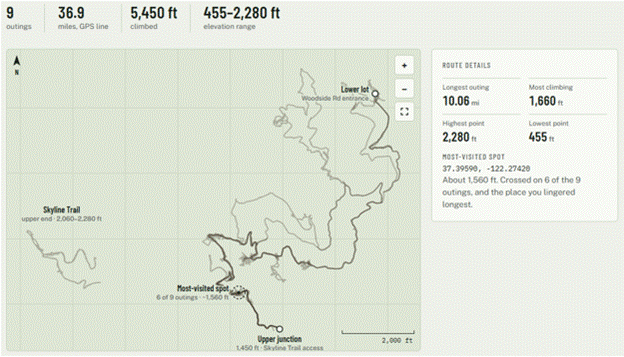
Five months, countless clues, multiple searchers, and plenty of miles on the trails ultimately led to one successful discovery! Golden Crossroads #2, created by Tom of Redmark Treasure, challenged searchers with a mix of riddles, ciphers, hidden connections, and real-world exploration. As the hunt unfolded, several searchers made their way through the clues and into the final stages, but it was Lawrence (LowRents) who ultimately found the gold coin after nine visits and more than 36 miles of hiking!
For this Six Questions, we’re bringing both sides of the adventure together. Tom shares his vision for the hunt, what he observed as searchers worked through the clues, and the excitement of seeing his treasure finally discovered. Lawrence takes us through his solving process, the moment the treasure was found, and the lessons he took away from the experience.
From the creator’s perspective to the finder’s big moment, here’s the story behind Golden Crossroads #2!
Enjoy the Six Questions! (and Join discussions of hunts on the MW Discord , MW Facebook Page , or MW Forum )
First 3 Questions with Tom (Creator of GC2):
- Q1) Congrats on the successful ending of Golden Crossroads #2! When you released the clues in May, what was your vision for this hunt? What did you hope searchers would experience as they worked through the clues and eventually discovered the gold coin? Did the hunt go as expected?
Thank you, I appreciate the opportunity to answer your questions about the treasure hunt solution. I also want to thank everyone who joined the hunt and put so much effort and time into trying to solve it. A big congratulations to Lawrence for solving it right at the end of 5 months.
The overall objective of Redmark Treasure hunts is to create hunts that are solvable within 6-12 months. I get it, I’m a treasure hunter too. My experience is that hunters lose interest if they don’t feel they are making some progress or don’t receive any confirmation or validation along their journey. My vision was to create a fun and personally rewarding hunt that tested and validated the hunter’s clue solving abilities. As a BOTG creator I also wanted to test their outdoors trail hiking and navigation abilities. It was designed to guide hunters on a path that would provide several checkpoints and validation along the journey. I want them to be able to say “ah-ha!” and “Yes!” all along the way. Isn’t that more fun that multi-year hunts with no validation?
I want to share that the hunt actually started way back in the beginning of the year. I was a guest speaker at the Cowlazars Seeking Treasure Confrence where I spoke about creating BOTG hunts and dropped a hint about this hunt. My tip for new hunters was to make sure they educated themselves in the various types of puzzles, riddles, cyphers and codes used by treasure creators. I actually mentioned that I learned by using your book. In this hunt I literally threw the whole book at them. I joked that I should have put an image of a kitchen sink on the treasure map because everything else was there. It began with a poem, riddle and fence rail cypher. As hunters progressed I added a cootie catcher, route cypher, key cypher, trail markers, landmarks with hidden compass triangulation coordinates, and finally a Goonies-style doubloon monocle.
I think the hunt went as I expected. Several hunters methodically worked through the clues and progressed to the next stages. At the end several people were in the final stage of the hunt. I was getting various information about their progress, and it was a real nail-biter for me. I think it came down to who had the endurance and time to hike the various trails of the region.
- Q2) Over the months, multiple searchers worked on the hunt and physically went out looking for the coin. From your perspective, was there a particular clue, detail, or connection that searchers were consistently overlooking or misunderstanding? Was there something hiding in plain sight?
I think the main thing that the final stage hunters really had a problem with was the treasure map. There was a 5 step process to solve the various map images/clues to lead you to the hidden treasure box. Different hunters were solving different parts of it out of (my) order which may have confused them.
What was in plain site? The treasure box was actually hidden in plain site. That was another tip I provided at the con. I’m interested in GeoCaching and how those creators give you the exact coordinate to the cache, but make them look so normal that they blend in and you don’t recognize the hidden container. I tried to do that. I also did something to the box so when you touched this small log it would make a noise so you knew you had it.
- Q3) As the months passed, what were you thinking as you watched searchers investigate, develop theories, and head out into the field? Were there any moments when you thought someone was getting particularly close, or when you were surprised by the directions people took? What did you enjoy most about the hunt?
At first, I was seeing that ideas were all over the place, but eventually their solutions were starting to fall into place. Because the treasure was hidden “somewhere in California” I knew it could be a trip to get to the location. So, I publicly offered advice to solve everything before you make the trip. I think hunters would solve one thing and then make the drive to the park. That probably helped in understanding the park but meant multiple trips which may have worn them out.
As I want my hunts solved, I started publishing clues on the monthly anniversary dates for each of the 3 progressive clue sets. I don’t know if the clues helped much. I think the final stage hunters are just amazing clue solvers on their own. At the end I think there were 6 hunters on the verge of discovering it. It could have been any one of them. During our solution party myself and the other hunters applauded the winner – Lawrence, for his skill, determination, persistence and stamina. I think its ok to share that he logged 9 visits and hiked over 36 miles to find it. The others graciously said he deserved it!
- BonusQ: When you learned the coin had finally been found, did the solution unfold the way you had envisioned?
Bonus: As the hunt unfolded I do think it went as planned. I am always pleasantly amazed at how clever hunters are and how some come up with a different approach but get the correct answer. I can’t explain it.
The thrill of finding the hidden treasure box is so visceral and emotional. In last year’s GC-1, and this year’s GC-2 hunts I had the pleasure of seeing videos and pictures when they found the box, and speaking to them within moments of the find. It’s so rewarding to see their exuberance!
I think most treasure hunt creators will agree that for the most part there is no positive financial ROI in creating a hunt! If you take that approach – witnessing the discovery is Priceless! And goes to fueling the next hunt.
Thank you again. Tom.
Questions with Lawrence/LowRents – The FINDER!
- Q4) Congrats on finding the Golden Crossroads #2 Treasure! Can you walk us through how you approached the clues and solving the hunt? Was there a particular clue, connection, or realization that you knew you were on the right track? When taking the hunt out into the physical world, how did you narrow down where to look, and what was that experience like? Were there any false starts, unexpected challenges, or moments when you wondered if you were searching in the right place?
Thank you, Jenny. First, I want to recognize the imagination and care Tom put into Golden Crossroads #2. He combined historical research, wordplay, physical puzzles, and close observation of the landscape into an experience that continually asked us to adjust our thinking. I especially appreciated how the hunt encouraged us to become acquainted with the place itself. The history and surroundings mattered, and discovering those connections was rewarding.
A subject I return to frequently in my research is how searchers develop confidence. Treasure hunting gives us tremendous freedom to make connections, but an appealing interpretation still needs evidence. My approach is to ask what an idea allows us to investigate next. Does it identify something we can verify? Does it narrow the possibilities? Does it make a prediction that could turn out to be wrong? Klayman and Ha observed that people tend to test ideas by checking cases they expect to confirm them. That strategy is often reasonable, but the most informative test is the one most likely to prove the idea wrong. [1]
One of Tom’s strongest design decisions was his webpage validation. At each stage, we would submit an answer and receive confirmation that we had successfully completed that part of the hunt. Those moments were as thrilling as finding the cache itself. After investing time in research and fieldwork, receiving that confirmation gave me undeniable confidence in our progress and strong assurance that we were working in the right area and making tangible progress.
Other hunts have provided similar experiences through coordinate checkers, intermediate discoveries, or accepted puzzle answers. Geocaching’s Mystery Cache checker verifies coordinates before the physical search, while multi-caches provide stages that lead onward. MIT Mystery Hunt participants likewise describe answer checking that confirms individual solutions. Each gives the searcher feedback independent of how persuasive their own theory feels. [2–4]
Tom used that principle exceptionally well. His validation system gave us firm ground from which to approach the next challenge. We still had substantial work ahead, but we could separate what we had established from what remained uncertain.
Loewenstein’s information-gap theory offers a useful perspective on that excitement. His account connects curiosity with awareness of something we want to understand. A successful checkpoint resolves one uncertainty while the next clue introduces another. [5] That describes the experience closely: the satisfaction of confirmation immediately became anticipation.
Kivetz, Urminsky, and Zheng add another dimension. In their studies of reward programs, people accelerated their effort as the goal came closer, and even the perception of progress increased motivation. [6] A confirmed checkpoint makes progress visible in a way few hunts manage.
The hunt also encouraged different ways of working. Sometimes progress came through research; elsewhere, the material required physical interaction or comparison with the landscape. Research on interactivity and insight examines how manipulating materials can help people restructure a problem. [7] I appreciated that dimension of Tom’s design. It encouraged us to experiment with the clues and experience the surroundings directly.
Taking the hunt into the field also meant learning the difference between scouting and searching. Scouting builds your understanding of the environment. You learn the routes, examine features, and check assumptions that are difficult to resolve from a screen. Searching concentrates your effort on locating the object within an area supported by the evidence.
Research on exploration and exploitation offers a useful parallel. Wilson and colleagues studied how people balance gathering information with pursuing an already promising option. [8] Applied to hunting, that suggests evaluating a trip partly by what it teaches you. An outing can improve the next decision even when you return without the treasure.
The successful discovery outing was my ninth visit. There were interpretations along the way that remained uncertain, and I would not want the eventual success to make the process sound inevitable. The important change near the end was that our reading became specific enough to identify a defined target. We sent Tom a drawing of that target before the successful visit:
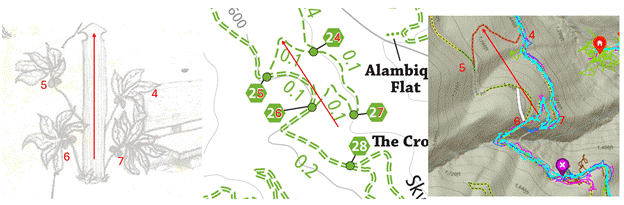
That record was important to me. Fischhoff’s 1975 experiments first described what became known as hindsight bias: people who learned how events turned out judged that outcome more likely and were largely unaware that the knowledge had shifted their judgment. [9] Ash and Wiley later examined how earlier judgments can be reconstructed after working through a problem. [10] Having the drawing preserves what we expected before knowing the outcome. We had reached a point where our interpretation could be tested in a particular place.
What I admire most about Tom’s work is how he sustained that progression. He gave us opportunities to investigate, moments of genuine confirmation, and reasons to return with better questions. Finding the cache was the culmination, but the hunt had already delivered several memorable experiences of discovery.
- Q5) Please take us to the moment you found the proxy item! What happened when you spotted it? Did you immediately recognize what you had found, and what went through your mind? Was there anyone else there to share that moment with you?
The successful visit was on a cool, pleasant afternoon, and my wife, Amy, was with me. By then the search had changed character. Once we had actually solved the final stage, we were no longer exploring an area. We walked directly to the spot we had identified and spent less than a minute searching before Amy found it.
The speed of that final search was no accident. Malcolm and Henderson found that people locate objects in real scenes faster when they hold a specific picture of the target in mind, and that knowing the likely context helps further. [11] By then we had both: a defined spot and a drawing of what we expected.
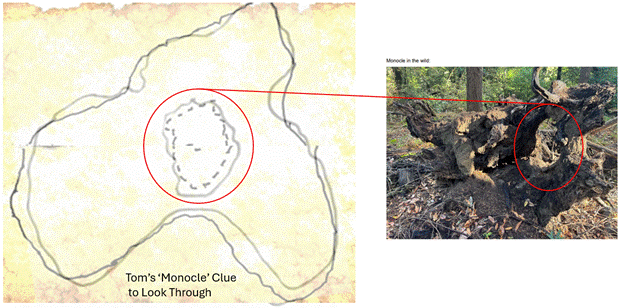
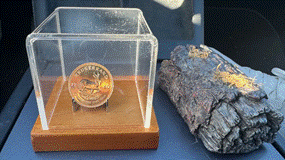
What Amy found was Tom’s proxy item: a fake log holding a vial with a passphrase to enter on the final website confirmation page. It was convincing enough that she first took it for a piece of petrified wood. Only when she picked it up did the AirTag inside begin beeping, and that sound told her what she was holding.
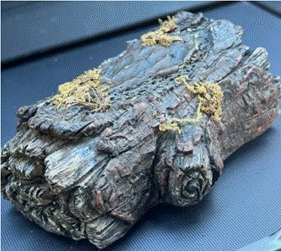
Biologists call this masquerade. Skelhorn and colleagues showed that twig-like caterpillars escape bird predators not because they go unseen, but because they are seen and dismissed as twigs. [12] Tom’s log worked the same way. Amy found it and even picked it up thinking it was petrified wood; the disguise was in what she took it to be.
I appreciate that moment on two levels. As a searcher, it illustrated a point I return to often: reaching the right place and actually seeing the object are two different accomplishments. Our reading had brought us to the spot, but someone still had to recognize what was there. Amy’s elf eyes did exactly that. Having a skilled spotter with boots on the ground is essential, and I was incredibly proud of her.
On a personal level, her excitement was the best part. Research by Boothby, Clark, and Bargh suggests that experiences become more intense when they are shared. [13] I believe it. Watching Amy’s reaction made the moment larger than it would have been alone.
All the time, research, and trips we had put in came together in that reaction. Norton, Mochon, and Ariely found that effort increases how much we value an outcome, but only when the work is completed successfully. [14] Nine visits made the find sweeter, but only because the ninth one ended with Amy holding the log.
As soon as we had cell service, I contacted Tom. He met us at the site and presented us with the coin. Finishing the hunt in the place where it ended, with the person who designed it, made a fitting close to the experience.
- Q6) After a lot of investigating and finally finding the treasure, what stands out most about this experience? What advice would you give other searchers working on active hunts, particularly when they feel they’ve exhausted their ideas or are struggling to make the clues fit?
What stands out most is the quality of the experience Tom created. His hunt sustained curiosity across research, puzzle-solving, and repeated visits to the landscape. The webpage validations gave us unmistakable evidence of progress at each stage, and I have appreciation for the thought that went into creating them.
My advice to other searchers would begin with the quality of their persistence. The successful outing was my ninth visit, but the number of visits is only part of the story. A return becomes productive when you bring a better question, test a different interpretation, or improve the way you examine the area. Effort matters most when it produces learning.
I would start by separating what a clue explicitly provides, what you have inferred, and what you have independently verified. An assumption can become familiar enough that we stop recognizing it as an assumption. Writing those three categories down helps reveal where a theory actually needs work.
Research on the illusion of explanatory depth is relevant here; Rozenblit and Keil found that people often believed they understood mechanisms more thoroughly than they could demonstrate when asked to explain them. [15] A useful application is to explain your solve step by step to someone unfamiliar with it. Can they follow the reasoning from the original material, or do important steps depend on additional assumptions?
I would also take fixation seriously. In Luchins’ classic water-jar experiments, people who had learned a method that worked kept applying it even after a simpler solution became available. [16] Decades later, Bilalić, McLeod, and Gobet studied expert chess players who had identified a familiar solution. Even when they reported looking for a better one, their attention remained drawn toward features associated with the existing solution. [17] We can sincerely intend to reconsider while continuing to look through the same interpretive frame.
When that happens, change the task deliberately. Return to the original clue without your annotations. Ask someone for an independent reading before explaining your theory. Consider what evidence would separate your preferred interpretation from another plausible one.
There is research behind making that comparison explicit. Lord, Lepper, and Preston found that considering an opposing possibility reduced bias in their social-judgment experiments more effectively than general instructions to be fair and unbiased. [18] The application to hunting is to give yourself a concrete question: What observation would make me reconsider this location?
That question can guide scouting. A trip devoted to resolving one important uncertainty may be more useful than another broad search. Establish whether a geographical relationship exists. Check a feature you have only seen in photographs. Find out whether a key assumption survives contact with the actual surroundings.
Once you begin searching, remember that selecting the right area and detecting the object are separate problems. The Coast Guard’s search-theory reference treats the probability that an object is within an area and the probability of detecting it there as two different measures. [19] An unsuccessful visit needs to be evaluated in light of both.
The search for Air France Flight 447 shows how much that difference matters. After two years without success, analysts rebuilt the probability map by estimating what each earlier search could realistically have detected. The wreckage was located within a week of the renewed effort. [20]
Expertise does not guarantee detection either. When Drew, Võ, and Wolfe placed an image of a gorilla in a lung scan, most radiologists searching for nodules did not report it, and many of them had looked directly at it. [21] Searchers concentrating on one expected feature can pass over something they did not anticipate. This is an especially powerful human condition that hunt creators benefit from when they obfuscate the nature of their containers.
Record where you looked, what you could inspect, and what remained unexamined. That helps you decide whether returning would meaningfully improve the search. It also helps prevent uncertainty about a missed object from becoming an indefinite justification for staying with a weak theory. Arkes and Blumer found that prior investment makes people more inclined to continue and more optimistic about success. [22] After several trips to the same area, the effort already spent can quietly argue for one more.
Formal checkpoints are particularly valuable because they establish a reliable point of progress. Tom’s validation system did that beautifully. It gave us confidence in completed stages while leaving the next interpretation open to examination. For hunts without formal validation, I would recommend writing down specific predictions before going out. Record what you expect to find and what would cause you to reconsider.
Taking a break can also be productive. Sio and Ormerod’s meta-analysis found an overall benefit from incubation, although the effect varied with the problem and the activity undertaken during the break. [23] After engaging seriously with a difficult clue, stepping away can create an opportunity to return with a different perspective.
Finally, I would protect your curiosity. Gruber, Gelman, and Ranganath found improved memory for information participants were curious about, along with incidental material encountered during those curious states. [24] Their experiments were not treasure hunts, but they offer a useful perspective on why an engaging question can make the surrounding experience so memorable.
That is part of Tom’s achievement. He gave us reasons to pay attention, learn about a place, and keep asking questions. The reward included those experiences as well as the final discovery.
For someone who feels they have exhausted their ideas, I would suggest making the next question smaller and more answerable. Verify one observation. Examine one assumption. Test one alternative. Give yourself an opportunity to learn something that changes your next decision.
References
- Klayman & Ha (1987): Confirmation, disconfirmation, and information in hypothesis testing
- Geocaching: 3 Tips for Finding Mystery Caches
- Geocaching: How to Find a Multi-Cache
- MIT Admissions: Two Hundred Puzzles, participant account of answer checking
- Loewenstein (1994): The Psychology of Curiosity
- Kivetz, Urminsky, & Zheng (2006): The goal-gradient hypothesis resurrected
- Incubation and interactivity in insight problem solving
- Wilson et al. (2014): Humans use directed and random exploration
- Fischhoff (1975): Hindsight ≠ foresight: the effect of outcome knowledge on judgment under uncertainty
- Ash & Wiley (2008): Hindsight bias in insight and mathematical problem solving
- Malcolm & Henderson (2009): The effects of target template specificity on visual search in real-world scenes
- Skelhorn, Rowland, Speed, & Ruxton (2010): Masquerade: camouflage without crypsis
- Boothby, Clark, & Bargh (2014): Shared experiences are amplified
- Norton, Mochon, & Ariely (2012): The IKEA effect: when labor leads to love
- Rozenblit & Keil (2002): The misunderstood limits of folk science: an illusion of explanatory depth
- Luchins (1942): Mechanization in problem solving: The effect of Einstellung. Psychological Monographs, 54(6), Whole No. 248.
- Bilalić, McLeod, & Gobet (2008): Why good thoughts block better ones
- Lord, Lepper, & Preston (1984): Considering the opposite
- Frost, with the U.S. Coast Guard: The Theory of Search
- Stone, Keller, Kratzke, & Strumpfer (2014): Search for the Wreckage of Air France Flight AF 447
- Drew, Võ, & Wolfe (2013): The invisible gorilla strikes again
- Arkes & Blumer (1985): The psychology of sunk cost
- Sio & Ormerod (2009): Does incubation enhance problem solving? A meta-analytic review
- Gruber, Gelman, & Ranganath (2014): States of curiosity modulate hippocampus-dependent learning